

Event Planning Process Step by Step Guide: From First Idea to Final Report
Planning an event can feel like juggling a hundred tasks at once. The venue wants a deposit, the speakers want a briefing, finance wants a budget, and you are still not sure who is actually coming. Most of that stress does not come from the amount of work. It comes from not knowing what to do first.
This event planning process step by step guide gives you a fixed order to work in. If you have ever wondered how to plan an event without losing track, the answer is a clear event planning process with defined event planning steps, an owner for every task and a timeline that works backwards from the event date. You will find eight stages from first idea to final report, a 12-month timeline, a simple who-does-what overview and the mistakes we see most often. The guide also explains where the event management process takes over from planning, so you know which tasks belong where.
What Is the Event Planning Process?
The event planning process is the sequence of decisions and tasks that turns an idea into a finished event. It starts with a goal ("we want 150 qualified customers at our product day") and ends with a review that tells you whether you reached it.
Guides on the subject count anywhere between five and ten stages. The number matters less than the order. We use eight stages because two steps that other models merge deserve their own place: the final two weeks before the event, when most last-minute problems appear, and the close-out after the event, which is the part teams most often skip. Each stage has a clear result, so you always know when you can move on.
How to Plan an Event: 8 Stages From Idea to Wrap-Up
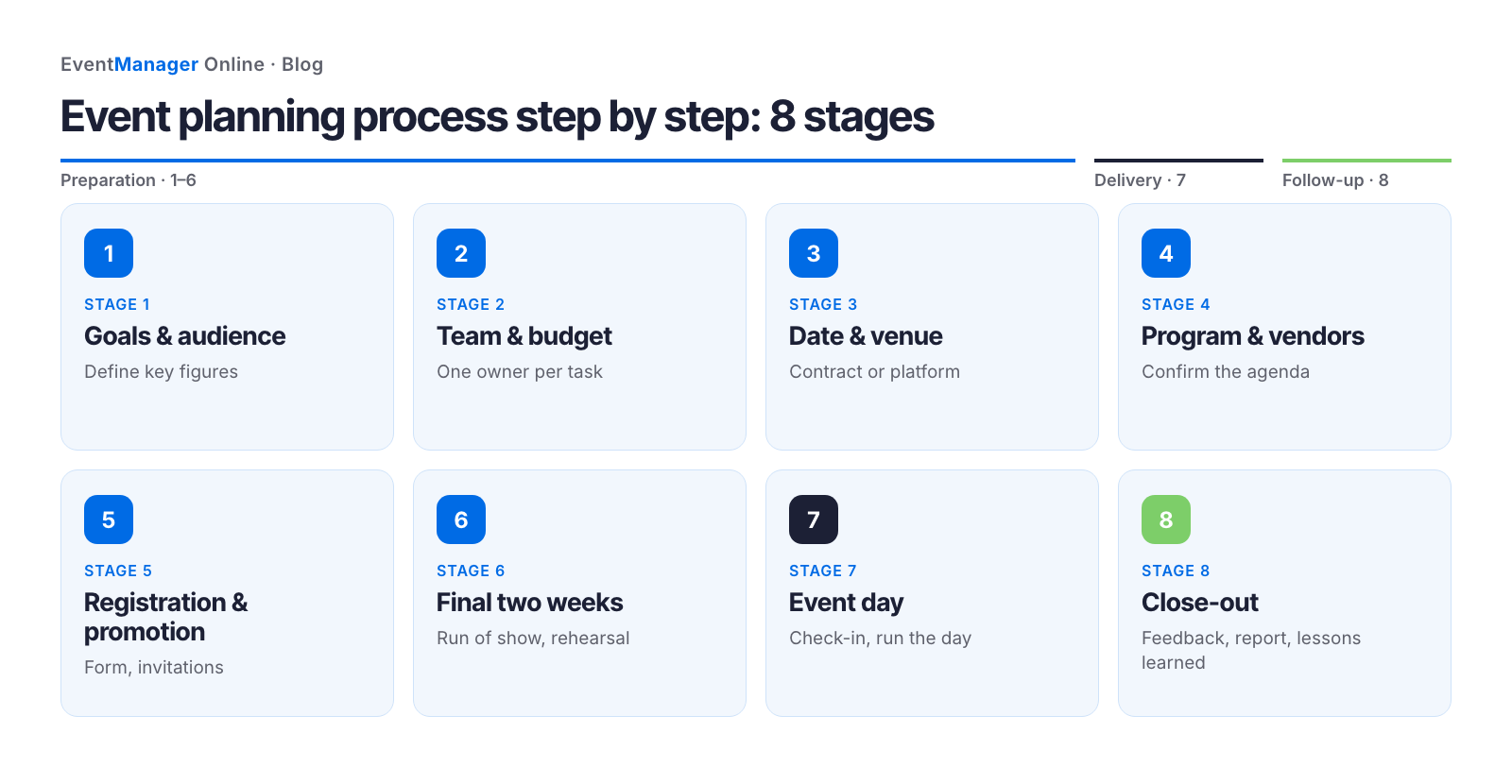
Stage 1: Set goals and define the audience
Write down what the event should achieve and how you will measure it. "Raise awareness" is hard to measure. "200 registrations from target accounts, 60% show-up rate, 20 sales conversations booked" is not. Then describe the audience: who they are, why they would come, and what would make them stay away. Every later decision, from venue size to the date, follows from these two answers. Result of this stage: a one-page brief with goals, key figures and target audience.
Stage 2: Build the team and set a budget
Name one person who owns the whole event and one owner for each work area: content, venue and logistics, marketing, registration, and finance. One owner per task does not mean one person does all the work. It means one person is accountable and nobody has to guess. Set the budget at the same time and include a contingency of around 10% for things you cannot foresee. Result: a team list with responsibilities and an approved budget.
Stage 3: Choose the date and venue
Check the date against holidays, trade fairs in your industry and your own company calendar. For the venue, look beyond the room size: accessibility, public transport, technical equipment, catering rules and cancellation terms all matter. For virtual or hybrid formats, the "venue" is your streaming platform and studio setup, and it needs the same scrutiny. Result: a signed venue contract or a confirmed platform.
Stage 4: Plan the program and book vendors
Draft the agenda, invite speakers and confirm them in writing with clear deadlines for slides and bios. Book the vendors you need: catering, AV technology, photography, printing, transport. Ask each vendor for a contact person on the event day. Result: a confirmed agenda and a vendor list with contacts and deadlines.
Stage 5: Open registration and promote the event
Build the registration form, decide which data you really need and set up confirmation emails. If you sell tickets, you will need online registration and payments that issue invoices automatically. Then start promotion: invitations to existing contacts, a landing page, social posts and reminders. Watch registrations weekly against your target. Result: open registration and a promotion plan that runs until the event.
Stage 6: Final preparations in the last two weeks
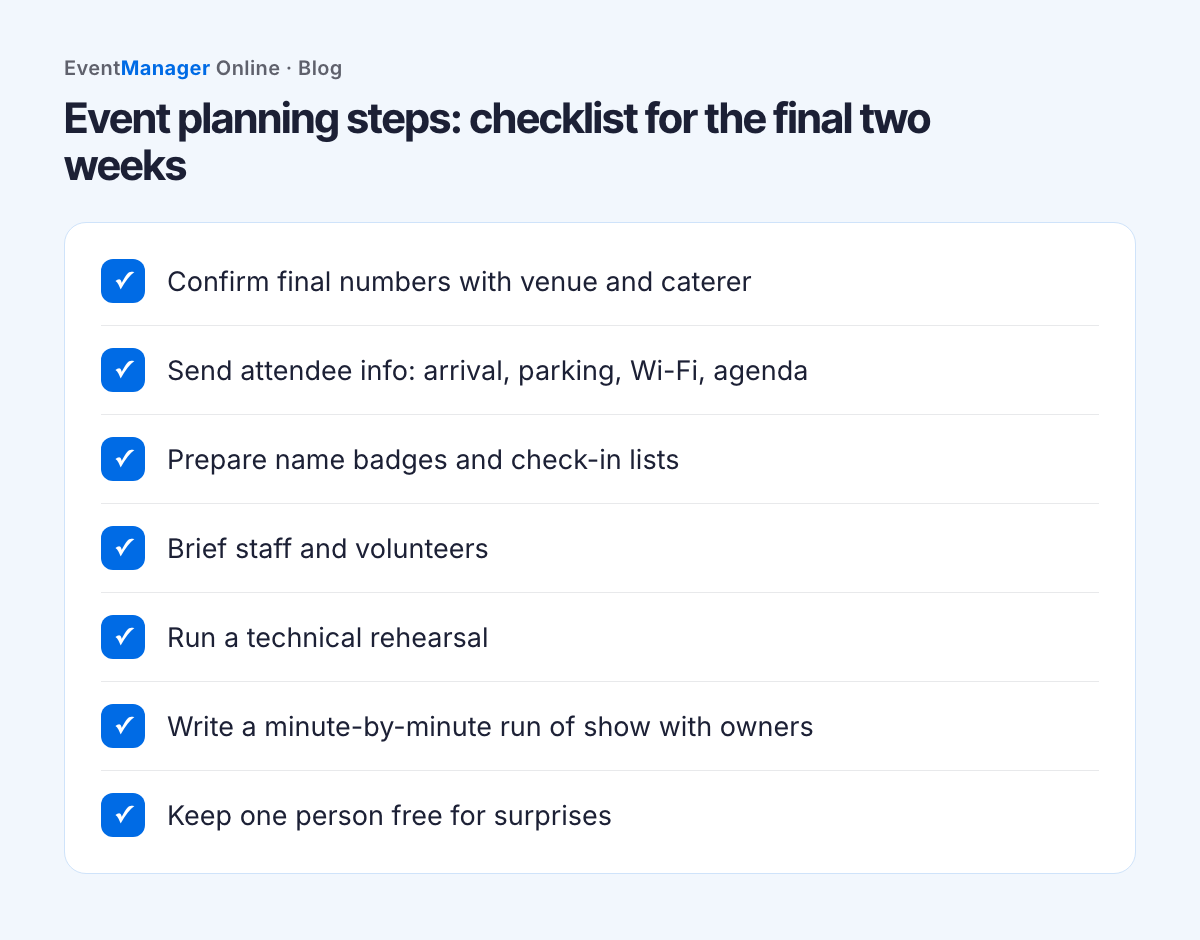
This is when small gaps become visible. Confirm final numbers with the venue and caterer, send attendees practical information (arrival, parking, Wi-Fi, agenda), prepare name badges and check-in lists, brief staff and volunteers, and run a technical rehearsal. Write a run of show that lists every item of the day minute by minute, with the person responsible next to it. Result: a complete run of show and a team that knows it.
Stage 7: Run the event day
Arrive early and walk through the run of show with the team. Keep one person free of fixed tasks to handle surprises. Track check-ins so you know the actual attendance, and collect notes on what goes wrong while it is still fresh. Result: a delivered event and real attendance figures.
Stage 8: Close out with feedback, reporting and lessons learned
Send a thank-you message and a short feedback survey within one or two days. Compare results against the goals from stage 1: registrations, show-up rate, budget, leads, satisfaction. Pay the remaining invoices, then hold a 30-minute review with the team: what worked, what did not, what you will change next time. Write it down. That document is the most valuable input for your next event. Result: a final report with figures and lessons learned.
Event Planning Steps by Lead Time: A 12-Month Timeline
Lead times depend on the size of the event. A conference for 500 people needs far more time than an internal workshop. The timeline below is based on a mid-sized business event with 100 to 300 participants. For smaller events, compress it; for large conferences, add months at the start, especially for the venue.

- 12 months before: define goals and audience, set a rough budget, name the event owner, shortlist dates.
- 6 months before: book the venue, build the team, confirm keynote speakers, set the final budget.
- 3 months before: finalize the agenda, book catering and AV, set up the registration page, start the first invitations.
- 2 months before: open registration, launch promotion, confirm all speakers in writing, plan accessibility.
- 1 month before: send reminders, collect speaker slides, order print materials, check registration figures against your target.
- 2 weeks before: confirm final numbers, send attendee information, prepare badges and check-in, write the run of show.
- Event week: technical rehearsal, team briefing, final reminder to attendees, set-up at the venue.
- After the event: thank-you message and feedback survey within one or two days, final report within two weeks.
Event Planning Workflow: Who Does What
Even small teams benefit from clear roles. A person can hold more than one role, but each role should have exactly one name next to it.
- Event owner: keeps the goals, budget and timeline in view and makes final decisions.
- Content lead: agenda, speakers, presentations and moderation.
- Logistics lead: venue, catering, technology, signage and vendors.
- Marketing lead: invitations, landing page, social media and reminders.
- Registration and attendee contact: registration form, questions from attendees, check-in and participant lists.
- Finance: budget tracking, ticket revenue, invoices and payments to vendors.
A short weekly meeting of 20 minutes is usually enough to keep everyone aligned. Use one shared task list rather than separate spreadsheets, so everyone works from the same status.
Common Planning Mistakes (and How to Avoid Them)
- No measurable goal. Without a target, you cannot tell afterwards whether the event worked. Define two or three key figures in stage 1.
- Booking the venue before knowing the audience. A room that is too large feels empty, one that is too small turns people away. Estimate attendance first.
- Underestimating no-shows. For free events, a show-up rate well below 100% is normal. Plan catering for the realistic number and send reminders.
- Tasks without owners. "The team will handle it" means nobody does. Assign every task to a name.
- A registration form that asks too much. Every additional field costs registrations. Ask only for what you will actually use.
- Skipping the review. The same problems return at the next event. Book the review meeting before the event takes place.
Event planning vs. the event management process: what is the difference?
Event planning covers everything that happens before the event: goals, budget, venue, program and promotion. Event management is broader. It includes planning but also the coordination on the day, attendee management, communication during the event and the follow-up afterwards. In practice, the two overlap. Stages 1 to 6 of this guide are planning, stages 7 and 8 are management.
FAQs
What are the 7 stages of event planning?
A common seven-stage model is: set goals, plan the budget, choose date and venue, plan the program, promote the event, run the event, and evaluate it. Our eight-stage model adds the final two weeks of preparation as a separate stage, because that is when most last-minute problems appear.
What are the 5 P's of event planning?
The 5 P's usually stand for Plan, Partner, Place, Practice and Permission. They are a quick checklist: Is there a plan, are partners and vendors on board, is the place right, has the team rehearsed, and are all permits in place?
What are the 10 steps to plan an event?
Ten-step models split the same work into smaller pieces: goals, team, budget, date, venue, program, vendors, registration, promotion and follow-up. The order matters more than the count. Start with goals and budget, and never skip the follow-up.
How far in advance should you start planning an event?
For a business event with 100 to 300 people, start about 6 to 12 months ahead. Small internal events can be planned in 4 to 8 weeks. Large conferences often book their venue more than a year in advance.
What is the difference between event planning and event management?
Event planning is the preparation: goals, budget, venue, program and promotion. Event management includes planning plus running the event day, managing attendees and handling the follow-up.
Conclusion
A good event is rarely the result of luck. It comes from a clear order of work: goals first, then team and budget, then venue, program, registration and promotion, followed by careful final preparation, a well-run event day and an honest review. If you assign one owner to every task and plan backwards from the event date, most of the stress disappears.
If you want registration, payments, check-in and feedback in one place, try our event planning software free for 14 days.


